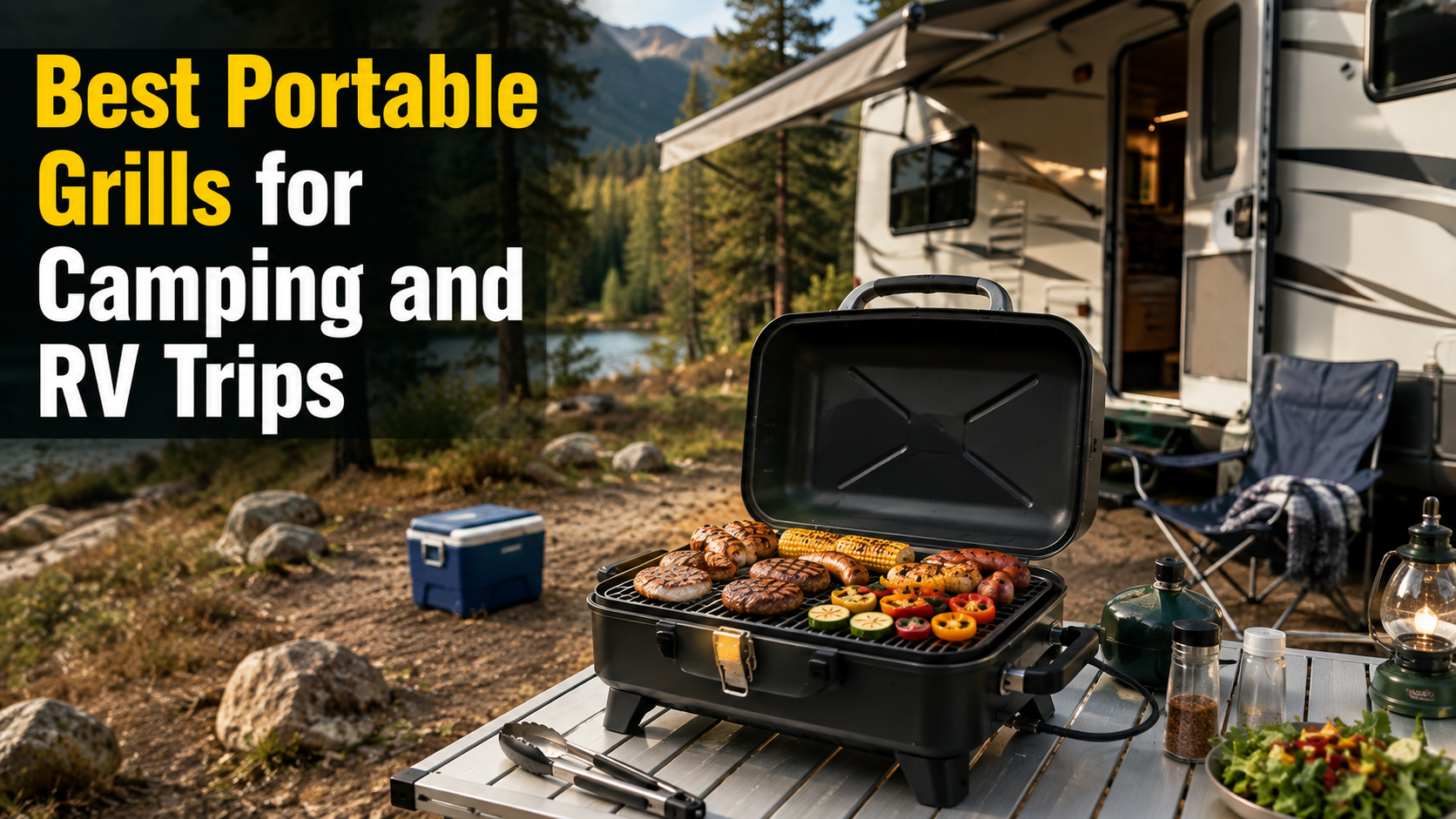
Camping, RV trips, road trips, and outdoor weekends demand more from a grill than backyard cooking. A portable grill must travel well, set up quickly, cook reliably, clean without drama, and store in limited vehicle or RV space. The best portable grills for camping and RV trips balance cooking area, weight, fuel type, temperature control, and durability so you can prepare burgers, steaks, chicken, vegetables, or breakfast without hauling a full-size unit.
The right choice depends on your trips. Backpack-style or walk-in sites favor lighter models. Car camping and family outings support medium sizes. RV travelers often prefer something with more capacity that still fits storage compartments and rolls easily around a campsite. Propane offers speed and control; charcoal delivers classic flavor with more cleanup; electric works only where power is available. This guide compares current options based on manufacturer specifications so you can match a grill to your travel style, group size, and storage limits.
Quick Comparison Table
| Grill | Best For | Cooking Area | Fuel | Weight | Key Advantage |
|---|---|---|---|---|---|
| Weber Traveler | Overall / RV trips | 320 sq in | Propane | 49 lbs | Folding design, wheels, solid capacity |
| Weber Traveler Compact | Compact camping | 240 sq in | Propane | 37 lbs | Smaller footprint, still capable |
| Coleman RoadTrip 285 | Families / Tailgating | 285 sq in | Propane | ~48 lbs | Three independent burners, high BTUs |
| Blackstone 22" Tabletop Griddle | Flat-top cooking | ~330–361 sq in | Propane | ~33–38 lbs | Versatile surface, dual zones, grease management |
| Weber Go-Anywhere Charcoal | Charcoal flavor | 160 sq in | Charcoal | ~11–12 lbs | Lightweight, classic results |
| Weber Smokey Joe (14") | Compact charcoal | 147 sq in | Charcoal | ~10 lbs | Simple, portable kettle style |
(Specifications drawn from current manufacturer listings. Weights and exact dimensions can vary slightly by configuration.)
Best Portable Grills for Camping and RV Trips
Weber Traveler Portable Gas Grill — Best Overall / Best for RV Trips
The Weber Traveler stands out for travelers who need meaningful cooking space without a full backyard footprint. Its 320-square-inch porcelain-enameled cast-iron cooking area handles about a dozen burgers. A single 13,000-BTU stainless-steel burner delivers a wide temperature range suitable for searing or lower-heat cooking. The one-piece design folds with a locking lid, raises with one hand via a lever, and rolls on durable all-weather wheels. Closed dimensions are roughly 37.2" H × 43.6" W × 23" D; open height reaches about 50". Listed weight is 49 pounds. A side table, tool hooks, front-access grease removal, and built-in lid thermometer add practicality. It uses disposable 1-pound propane cylinders (adapter options exist for larger tanks).
Based on manufacturer specifications, the folding construction and wheels make it practical for RV exterior storage or vehicle transport, while the cooking area supports family-sized meals better than ultra-compact tabletop units. Setup is straightforward once the unit is raised and the cylinder attached.
Key Specifications
- Fuel Type: Liquid propane
- Cooking Area: 320 sq in
- BTUs: 13,000
- Dimensions (closed): ~37.2" H × 43.6" W × 23" D
- Weight: 49 lbs
- Grate: Porcelain-enameled cast iron
- Burners: 1
- Best For: RV travelers, car campers, families of 3–4
Pros
- Solid cooking capacity for the portable class
- Smooth folding and rolling design
- Durable grates and build quality consistent with Weber
- Easy grease access
Cons
- 49 pounds is substantial for long carries
- Single burner limits independent heat zones
- Larger folded size than true tabletop models
Best For
RV owners and car campers who want reliable performance and do not mind moderate weight.
What to Know Before Buying
Confirm it fits your storage compartment or vehicle. Check campground rules on propane use and open-flame cooking.
Weber Traveler Compact Portable Gas Grill — Best Compact Grill for Camping
The Compact version reduces the footprint while retaining the Traveler’s folding and rolling approach. It offers 240 square inches of cooking area (still listed as fitting up to 12 burgers in manufacturer materials), an 11,000-BTU burner, and a listed weight of 37 pounds. Closed dimensions shrink to roughly 34.75" H × 34" W × 21.5" D. Porcelain-enameled cast-iron grates, wheels, side table, and locking lid remain. It is about 20% smaller than the full Traveler and fits more easily in compact cars or tighter RV storage.
The tradeoff is clear: less cooking surface and slightly lower output in exchange for easier transport and storage. For couples or small groups prioritizing portability, the Compact is a strong match.
Key Specifications
- Fuel Type: Liquid propane
- Cooking Area: 240 sq in
- BTUs: 11,000
- Weight: 37 lbs
- Best For: Couples, weekend campers with limited space
Pros
- Noticeably lighter and more compact
- Same core folding and transport features
- Sufficient area for 2–3 people
Cons
- Reduced capacity for larger groups
- Still not backpack-light
Best For
Travelers who value easier packing over maximum cooking space.
Coleman RoadTrip 285 Portable Stand-Up Propane Grill — Best for Families / Tailgating
Coleman’s RoadTrip 285 provides 285 square inches of porcelain-coated cast-iron cooking area and up to 20,000 BTUs across three independently adjustable burners. This configuration allows better temperature zoning than single-burner designs. Features include quick-fold legs with wheels, two side tables, locking lid, Instastart ignition, integrated thermometer, and a removable water/grease pan. Listed weights fall in the mid-to-high 40-pound range depending on exact configuration. It stores upright and uses 1-pound propane cylinders.
The multi-burner control and higher total output suit families or groups cooking varied items at once. Folding legs and wheels aid campsite movement, though the unit is bulkier than pure tabletop models.
Key Specifications
- Fuel Type: Propane
- Cooking Area: 285 sq in
- BTUs: Up to 20,000
- Burners: 3 independent
- Weight: ~47–52 lbs
- Best For: Families, tailgaters, larger groups
Pros
- Excellent heat control via three burners
- High total BTU output
- Side tables and grease management help practicality
Cons
- Heavier and bulkier when folded
- Higher cost than basic tabletop options
Best For
Family camping, tailgating, or anyone needing zone cooking.
Blackstone 22-Inch Tabletop Griddle — Best Portable Griddle for Camping and RVs
A griddle differs from a traditional grill by offering a flat cooking surface instead of open grates. Blackstone’s 22-inch tabletop models typically provide roughly 330–361 square inches of cooking space across two independently controlled heat zones, with total BTU output often listed around 21,000–24,000. Weights run approximately 33–38 pounds. Key features include rear grease management, piezo ignition, and (on many versions) a built-in hood. Some configurations allow the griddle top to flip for storage. Dimensions are compact for tabletop use (roughly 22–27" wide depending on exact model).
The flat surface excels at pancakes, eggs, bacon, hash browns, smash burgers, fajitas, stir-fry, and vegetables—foods that benefit from full contact rather than grill marks. Dual zones let you cook different items simultaneously. It is highly practical for RV and car-camping breakfasts or mixed meals, though it will not produce classic grill sear marks.
Key Specifications
- Fuel Type: Propane
- Cooking Area: ~330–361 sq in
- Burners: 2 independent
- Weight: ~33–38 lbs
- Best For: Breakfast-focused or versatile flat-top cooking
Pros
- High versatility for non-traditional grill foods
- Dual zones and grease system simplify use
- Compact tabletop form
Cons
- Requires a stable table or stand
- Different results from grate-style grilling
- Hood and exact features vary by version
Best For
Campers and RV travelers who cook breakfast or mixed meals regularly.
Weber Go-Anywhere Charcoal Grill — Best Charcoal Option
For classic charcoal flavor in a compact package, the Weber Go-Anywhere delivers 160 square inches of cooking area in a rectangular design weighing about 11–12 pounds. Closed dimensions are roughly 15" H × 19.5" W × 11.5" D. Porcelain-enameled lid and base, plated-steel grate, locking legs that secure the lid for carrying, and adjustable dampers provide heat control. It is light enough for many car-camping or picnic uses and produces the smoke and sear many associate with traditional grilling.
Charcoal requires more setup time, ash management, and attention to fire restrictions than propane. Cleanup is messier, but the flavor payoff and low weight appeal to those prioritizing taste and simplicity.
Key Specifications
- Fuel Type: Charcoal
- Cooking Area: 160 sq in
- Weight: ~11.5 lbs
- Best For: Flavor-focused compact cooking
Pros
- Lightweight and easy to carry
- Authentic charcoal results
- Simple, durable construction
Cons
- Longer setup and cooldown
- Ash disposal and fire-rule considerations
- Smaller capacity
Best For
Charcoal enthusiasts on shorter trips or those with strict weight limits.
(A similar compact charcoal option is the Weber Smokey Joe 14-inch kettle with 147 square inches and roughly 10-pound weight for an even more traditional round design.)
Best Overall Portable Grill
The Weber Traveler earns the overall recommendation for most camping and RV users. Its 320-square-inch area, reliable single-burner performance, folding-and-rolling design, and solid build provide the best balance of capacity, transport practicality, and everyday usability. It is not the lightest or cheapest, but the combination of cooking space and thoughtful portability features suits the majority of car campers and RV travelers better than smaller tabletop units or bulkier multi-burner stands.
Best Portable Grill for RV Trips
RV travelers benefit from the Weber Traveler or the Coleman RoadTrip 285. Both offer enough cooking area for typical family meals, fold or collapse for storage compartments or exterior bays, and move reasonably around a campsite via wheels. Weight remains a consideration—confirm one person can lift and position the unit. Fuel storage (1-pound cylinders or adapter for larger tanks), quick setup after arrival, and the ability to clean before departure matter. Always verify RV park and campground rules regarding open flames, propane, and placement distances from the vehicle or other structures.
Best Compact Grill for Camping
The Weber Traveler Compact or the lighter Weber Go-Anywhere (charcoal or gas versions) suit those prioritizing transport ease. Smaller cooking areas mean sequential cooking for larger groups, but the reduced weight and dimensions simplify packing and carrying from parking to site.
Best Portable Grill for Families
Look for 250+ square inches and preferably multiple burners or zones. The Coleman RoadTrip 285 or full-size Weber Traveler give families room for burgers, hot dogs, chicken, steaks, vegetables, and corn without constant rotation. Manufacturer cooking-area figures help estimate practical capacity more reliably than vague “feeds X people” claims.
Best Portable Griddle for Camping and RVs
The Blackstone 22-inch tabletop models excel when flat-top versatility is the priority. Dual heat zones and rear grease management support efficient cooking of breakfast spreads or mixed dinners. Pair with a stable outdoor table.
Best Charcoal Option
The Weber Go-Anywhere or Smokey Joe deliver authentic flavor in lightweight packages. Expect longer lighting and cooling times plus stricter attention to ash disposal and fire restrictions compared with propane.
Propane vs Charcoal vs Electric for Camping and RV Trips
| Feature | Propane | Charcoal | Electric |
|---|---|---|---|
| Setup Speed | Fast | Slower | Fast (with power) |
| Flavor | Clean | Smoky | Neutral |
| Temperature Control | Precise | Manual (dampers) | Precise |
| Cleanup | Easier | Ash and residue | Easiest |
| Fuel Availability | Widespread cylinders | Bags of charcoal | Outlet required |
| Portability | Good | Excellent (lighter units) | Good if power available |
| RV Use | Strong | Possible with care | Excellent at powered sites |
| Campsite Use | Widely accepted (check rules) | Subject to fire bans | Limited to powered sites |
| Power Requirement | None | None | Required |
| Smoke | Minimal | Noticeable | None |
Propane suits most RV and car-camping scenarios for speed and control. Charcoal appeals for flavor when time and rules allow. Electric works only at sites with reliable power and is ideal for strict fire-ban areas or indoor-adjacent RV use (never indoors without proper ventilation and manufacturer approval).
How to Choose the Right Grill Size
- 1–2 people: 150–240 sq in often suffices.
- 3–4 people: 240–320 sq in is more practical.
- 5+ people: Larger portable units or sequential cooking.
Larger area increases weight, storage needs, and fuel use. Match size to typical group and available vehicle/RV space.
What Weight Is Best for a Camping Grill?
“Portable” ranges widely. Under 15 pounds suits walk-in or frequent carrying. 30–40 pounds works for most car camping and short RV moves. 45–50+ pounds is manageable with wheels for RV or parking-lot-to-site use but inconvenient for longer carries. Consider the full distance from vehicle to cooking location.
What Features Matter Most in a Portable Camping Grill?
Folding design and locking lid simplify transport and prevent accidental opening.
Carry handles and wheels reduce effort; wheels help most on uneven ground when weight is higher.
Built-in thermometer improves temperature awareness.
Independent burners or zones enable better control for varied foods.
Grease management (removable pans or rear systems) speeds cleanup.
Cooking surface material (porcelain-enameled cast iron, stainless, or griddle steel) affects heat retention and maintenance—none is universally superior.
Portable Grill for RV: What to Consider
Prioritize folded dimensions that fit storage, manageable weight for one person, easy fuel access, rapid setup, and simple cleaning before travel. Secure the grill during driving. Confirm local rules at each stop.
Portable Grill for Tent Camping
Emphasize lower weight, compact packed size, simple fuel, and quick setup. Large wheeled stand-up models often prove impractical when gear must be carried any distance.
Can You Use a Portable Grill at a Campsite?
Rules vary by campground, national or state park, and current fire restrictions or burn bans. Always check regulations, weather, and fire danger levels. Use only where permitted, on a stable non-combustible surface, away from tents, vehicles, and vegetation. Never leave a lit grill unattended. Allow full cooling before packing. Dispose of charcoal or ash only as directed by the site.
Portable Grill Safety Tips
- Verify campsite and local fire rules.
- Read and follow the manufacturer’s manual.
- Place the grill on a stable, level surface.
- Keep clear of tents, RVs, dry vegetation, and other combustibles.
- Never operate an outdoor grill inside an RV, tent, vehicle, garage, or enclosed space.
- Never leave the grill unattended while lit.
- Handle and store propane cylinders according to manufacturer and transportation rules.
- Control grease buildup.
- Allow complete cooling before packing or transporting.
- Follow all disposal rules for ash or residue.
- Keep the cooking area clear of children and pets.
How to Transport a Portable Grill
Cool completely. Clean excess grease. Secure the lid and any locking mechanisms. Remove or secure loose accessories. Protect grates if needed. Store fuel separately and legally. Prevent shifting during travel—especially important in an RV. Use a protective cover or case when available.
How to Clean a Camping Grill
- Allow full cooling per manufacturer instructions.
- Remove food residue from grates or cooktop with recommended tools or methods.
- Empty and clean grease collection components.
- Wipe the exterior.
- Dry thoroughly before storage.
Cleaning before packing reduces leaks, odors, insects, and mess inside vehicles or RVs.
Camping Grill Buying Guide Checklist
- Cooking area matched to group size.
- Weight appropriate for transport distance.
- Folded dimensions that fit vehicle or RV storage.
- Preferred fuel type and availability.
- Temperature control needs.
- Setup speed.
- Cleaning ease.
- Build durability for outdoor use.
- Storage plan.
- Manufacturer warranty and parts support.
Common Portable Grill Buying Mistakes
- Choosing a unit too heavy for the intended carry.
- Ignoring folded size relative to storage.
- Buying excess capacity that goes unused.
- Selecting an inconvenient fuel type.
- Overlooking campground or fire rules.
- Neglecting grease management.
- Failing to plan RV storage space.
- Packing while still hot.
- Leaving accessories unsecured.
- Assuming every site permits grilling.
- Focusing only on BTU numbers.
- Skipping warranty and replacement-part availability.
Best Portable Grill by Type of Traveler
| Traveler Type | Recommended Approach | Why |
|---|---|---|
| RV traveler | Weber Traveler or Coleman RoadTrip 285 | Capacity + transport features |
| Car camper | Weber Traveler Compact or full Traveler | Balance of size and performance |
| Family camper | Coleman RoadTrip 285 or Weber Traveler | Cooking area and control |
| Couple / small group | Traveler Compact or Go-Anywhere | Easier packing |
| Tailgater | Coleman RoadTrip 285 | Power and side space |
| Weekend camper | Compact propane or charcoal | Quick use |
| Long road trip | Durable folding propane with good storage fit | Reliability over distance |
| Small-space / weight-sensitive | Go-Anywhere or Smokey Joe | Minimal bulk |
| Breakfast-focused | Blackstone 22" griddle | Flat-top versatility |
Frequently Asked Questions
What is the best portable grill for camping?
It depends on group size and fuel preference. The Weber Traveler or Compact suits many propane users; the Go-Anywhere works well for charcoal.
What is the best portable grill for an RV?
Models with solid capacity, folding designs, and wheels such as the Weber Traveler or Coleman RoadTrip 285 generally fit RV needs best.
What size grill is best for camping?
Match square inches to typical headcount: under 200 for 1–2 people, 240–320 for small families.
Is propane or charcoal better for camping?
Propane is usually more convenient; charcoal offers traditional flavor when rules and time allow.
Can you use a portable grill at an RV campground?
Often yes, but always confirm current rules, fire restrictions, and placement requirements.
What is the easiest camping grill to clean?
Propane models with accessible grease systems and smooth surfaces tend to be simpler than charcoal units with ash.
How heavy should a portable camping grill be?
Under 40 pounds is preferable for frequent carrying; heavier wheeled units work for short moves from vehicle or RV.
Can you use a portable grill inside an RV?
No. Outdoor grills are for outdoor use only due to carbon monoxide and fire risks.
What is the best portable grill for a family camping trip?
Units offering 280+ square inches and good heat control, such as the Coleman RoadTrip 285 or Weber Traveler.
Can you bring a portable grill to a national park?
Rules vary by park and current conditions. Check official regulations and fire bans before arrival.
Final Verdict
For most campers and RV travelers seeking the best portable grills for camping and RV trips, the Weber Traveler provides the strongest overall combination of cooking area, transport features, and build quality. The Traveler Compact serves those who need a smaller package. Families and tailgaters gain from the Coleman RoadTrip 285’s multi-burner control. Flat-top fans should consider a Blackstone 22-inch griddle. Charcoal enthusiasts will appreciate the lightweight Weber Go-Anywhere or Smokey Joe.
The ideal grill matches your typical group size, available storage, preferred fuel, and how far you must move it. Prioritize verified specifications, campsite rules, and practical features such as locking lids, grease management, and reasonable weight. With the right portable grill, outdoor cooking becomes a reliable part of the trip rather than a logistical burden. Explore more outdoor cooking options in the Grills & Outdoor Cooking category.